Behavioural tests for Go HTTP services
Build a request, send it to your handler, and assert on the response. Mock the services it calls, and get a sequence diagram of every test.
go get github.com/steinfletcher/apitest
How it reads
One readable chain per test
Everything before Expect describes the request. Everything after it describes the response. End runs the test.
func TestHello(t *testing.T) {
	apitest.New().
		HandlerFunc(helloHandler).
		Get("/hello").
		Query("name", "gopher").
		Expect(t).
		Status(http.StatusOK).
		Header("Content-Type", "application/json").
		Body(`{"message": "hello gopher"}`).
		End()
}
Every sample on this site is included from tests that run against the latest release.
Features
Everything a handler test needs
apitest covers the whole path of a request through your service, without asking you to change how it is built.
Reads like the request it makes
One fluent chain describes the request and the response you expect. No setup boilerplate, no servers, no ports.
Mock the services you call
Declarative mocks answer outbound HTTP calls, with matchers for paths, headers, query, body, cookies and more.
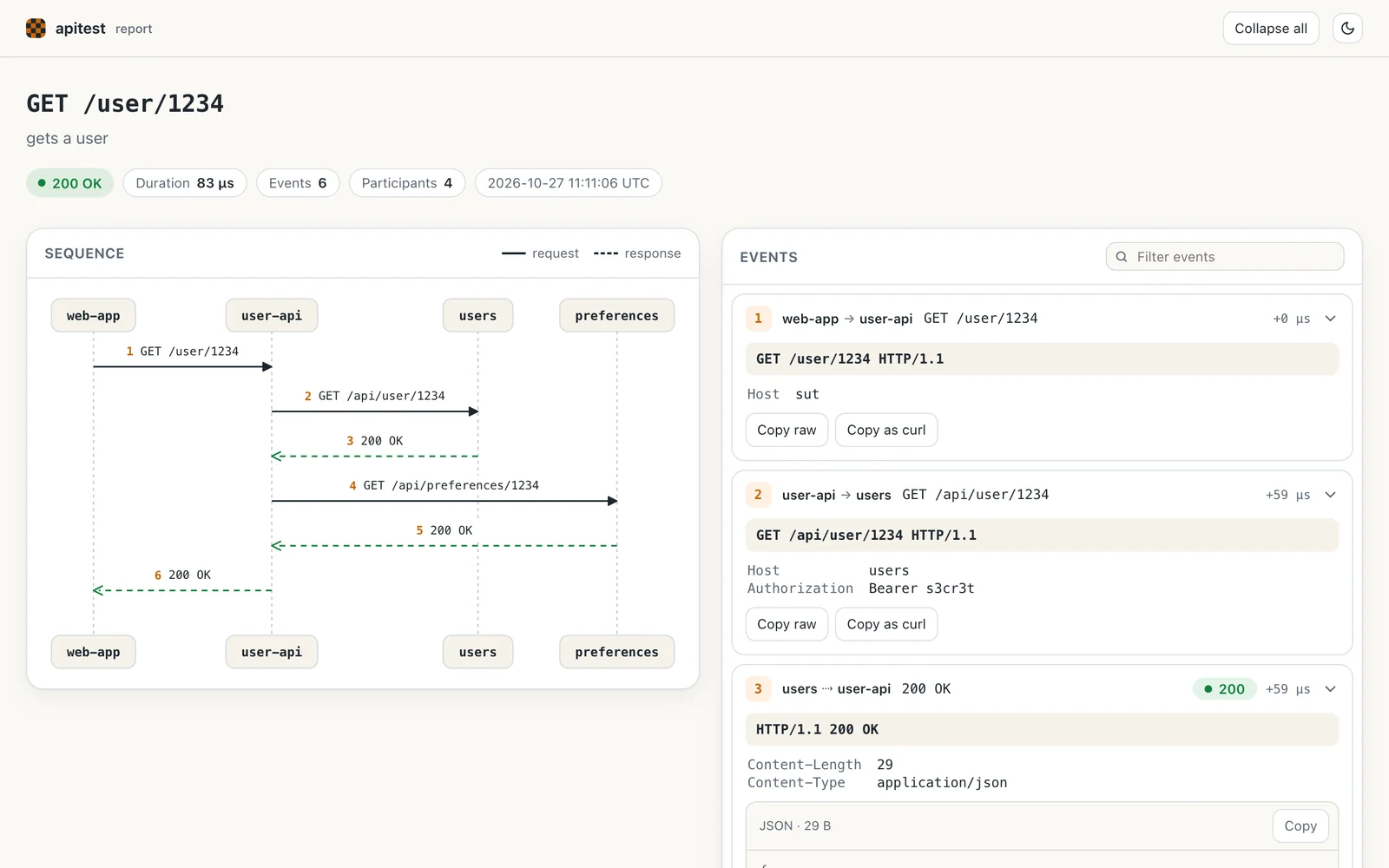
A diagram of every test
Render each test as a sequence diagram of the request, mocked calls, database queries and the response.
Any http.Handler
Works with net/http, chi, gin, echo, gorilla and anything else that serves HTTP, or a server over the network.
Zero dependencies
The core library depends only on the standard library. Extras such as JSONPath live in separate modules.
Extensible at every step
Custom assertions, mock matchers, verifiers, observers and report formatters are all plain Go functions and interfaces.
Anatomy of a test
Configure, request, expect
Every test has the same three parts, so a whole suite reads consistently.
- 1
Configuration
The handler under test, mocks for the services it calls, and options such as reporting and debug output.
- 2
Request
The method, URL, headers, query, cookies and body, built with a fluent API.
- 3
Expectations
The status, headers, cookies and body you expect, plus any custom assertions.
func TestGetUser(t *testing.T) {
	apitest.New("gets a user").
		// 1. configuration
		Mocks(getUserMock, getPreferencesMock).
		Handler(newUserAPI()).
		// 2. request
		Get("/user/1234").
		// 3. expectations
		Expect(t).
		Status(http.StatusOK).
		Body(`{"id": "1234", "name": "jon", "is_contactable": true}`).
		End()
}
Reports
See what your service actually did
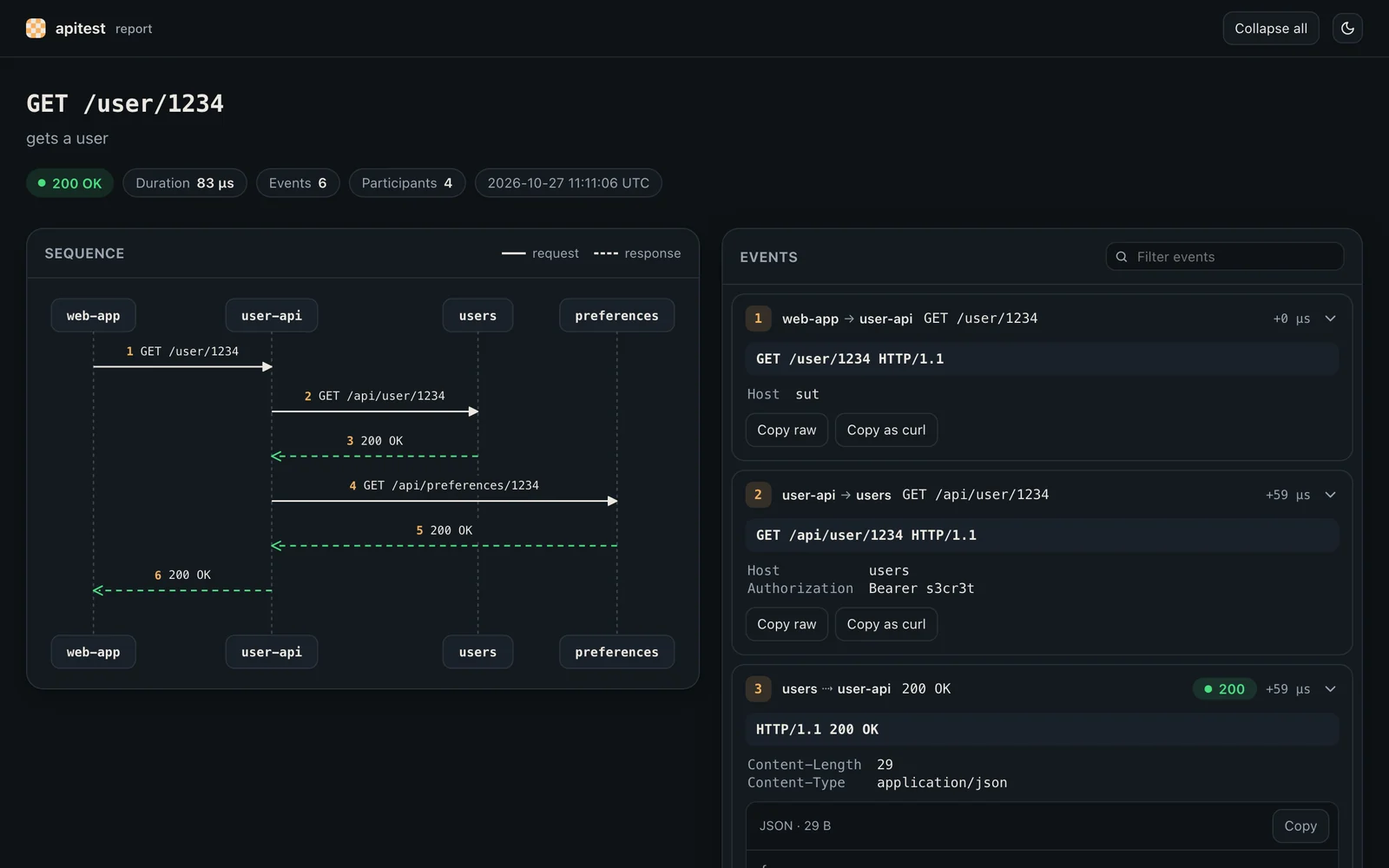
Add one line to a test and apitest writes a self-contained HTML report: an interactive sequence diagram of every interaction, the wire log of each message, and a flag on any call that matched no mock. Database queries and your own events can be drawn too.
Works with
Bring your own stack
If it serves HTTP in Go, apitest can test it.
- net/http
- chi
- gin
- echo
- gorilla/mux
- httprouter
- iris
- fiber
- gqlgen
- Ginkgo
- database/sql
Write your first test in a minute
Install the module, point it at a handler, and describe what should happen.
go get github.com/steinfletcher/apitest